

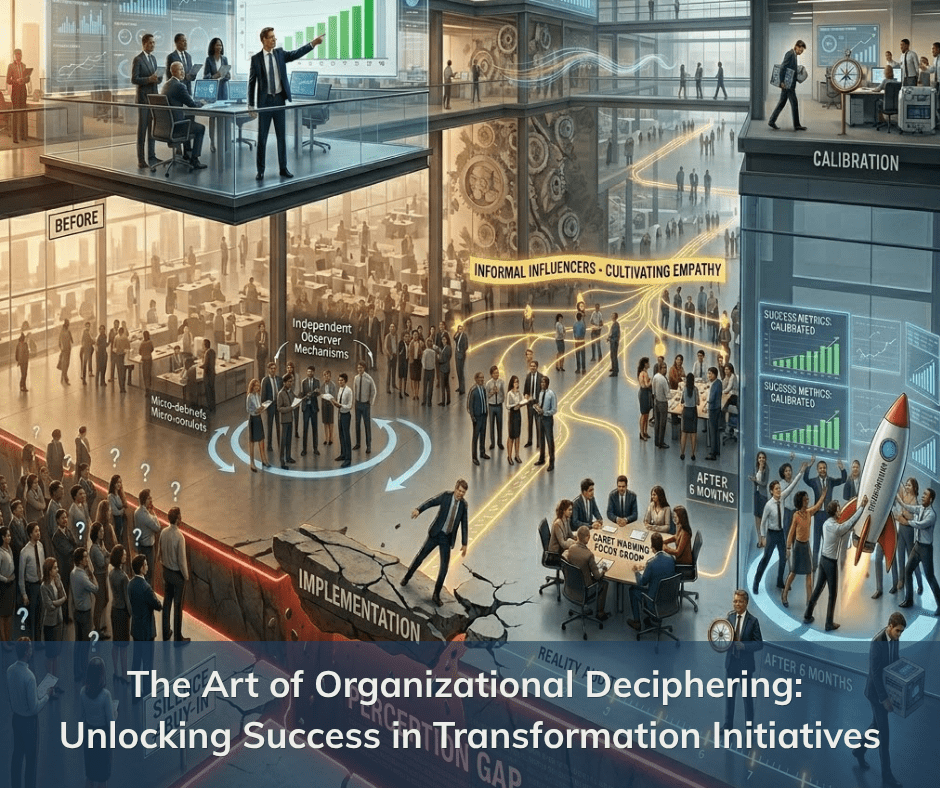
Introduction: The Blind Spot Behind the Metrics In modern management, a common scenario unfolds: restructuring plans designed with data-driven perfection collapse rapidly upon implementation. Statistics reveal that the majority of corporate transformation efforts fail not due to flawed strategies, but because of a disconnection between leadership and the workforce. When those at the helm lack the sensitivity to decipher human psychology, they inadvertently create a dangerous “perception gap,” where employee silence is misinterpreted as buy-in.
I. Diagnosing the “Perception Gap” with Empirical Data The first step in salvaging a stalling campaign is to quantify what leaders “perceive” versus what employees “experience.” Instead of viewing resistance as negative behavior, organizations should see it as a forecasting error in management’s predictive system.
-
Reality Audits: Directly compare a leader’s post-meeting assessment with anonymous feedback from subordinates. If a leader rates team enthusiasm at 9/10 while the actual pulse is 4/10, it signals a red alert regarding their organizational reading skills.
-
Independent Observation Mechanisms: Utilizing executive coaches or trusted peers to observe live interactions (Shadowing) helps expose blind spots that insiders often overlook due to an over-focus on technical goals.
II. Cultivating Empathy Through Immediate Feedback Loops The skill of understanding people cannot be honed through short-term theoretical workshops. It requires disciplined practice through continuous feedback loops in real-world settings.
-
Micro-debriefs: Immediately following key interactions, leaders should conduct rapid-fire sessions to reflect on how people responded and how their own reactions landed with the team.
-
Prediction and Calibration: Requiring leaders to predict team sentiment before major announcements, then verifying those predictions against real data, helps them recalibrate their psychological “filters” over time.
III. Structural Redesign to Compensate for Human Gaps When the pace of market change outstrips the human learning curve, organizations need systemic solutions to compensate for leaders with high technical expertise but limited soft skills.
-
Multi-layered Decision Mechanisms: Establish parallel information channels where “informal influencers” act as bridges, extending leadership’s reach into every corner of the organization.
-
Early Warning Systems: Implement regular focus groups to gather raw insights from lower-level staff, ensuring honest information flows upward without being filtered by insensitive middle management.
IV. Strategic Talent Decisions: When to Replace? Transformation management requires different leadership profiles for different phases. A brilliant technical expert may be an asset during stable periods but becomes an “Achilles’ heel” during volatile transitions if they lack an empathetic mindset.
-
The Six-Month Rule: If team engagement metrics fail to improve after six months of structured development and support, the organization must make a decisive talent move. Reassigning or replacing a leader is not a denial of their individual worth but an optimization of resources to meet the human demands of the transformation.